
The Ryokan Rx
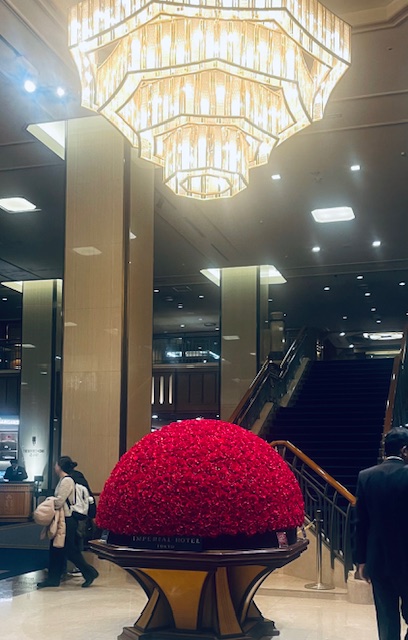
The Imperial Hotel, Tokyo, Japan
This past Saturday my partner and I saw the movie Marty Supreme, starring Timothée Chalamet and Gwyneth Paltrow. The film follows Marty Mauser, a 23-year-old Jewish kid from the Lower East Side of New York in 1952, a shoe salesman with an improbable dream of becoming the greatest table-tennis player in the world. The movie was riveting, and Chalamet’s performance exceptional.
Interestingly, Marty’s pursuit takes him to Tokyo, where he competes against Koto Kawaguchi, who plays himself in the film. Marty stays at the Imperial Hotel in Tokyo and, in a moment of perfect synchronicity, I had returned from that very hotel just one week earlier, having completed my first winter journey to Japan.
The movie echoed cultural contrasts I had just been living inside. Marty, the young American, is wild, immodest, expressive, unapologetically rude and rebellious—his movements large and fiery. His Japanese competitor is quiet, polite, obedient—his movements deliberate, thoughtful, precise.
Japan, I found, has a way of honoring the minimalist aesthetic at every level of life. In my observation, wildness does not exist there in the way we often define it. Instead, it is contained, ordained, approved, shaped into form. This orderliness is not rigid; it is the bedrock of harmony and spaciousness. Japan’s wild is organized beauty.
A bonsai tree captures this perfectly: a mature tree, pruned with intention, its vast root system contained within a small pot. Nothing is accidental. Nothing is excessive. And yet, life is fully expressed.
Japan has mastered the art of making space. It has had to. Japan has just under half the population of the United States, yet the U.S. has roughly twenty-five times more land.
Population
U.S.: ~344 million
Japan: ~123 million
Land size
U.S.: ~9.8 million km²
Japan: ~0.38 million km²
Space in Japan is not wasted. It is curated.
Midway through our trip, we found ourselves with three days unplanned. As the ambitious sightseeing urges—to see temples, shrines, museums, parks, and shops—fell away, something else took their place. Winter whispered rest. Cold wind and snow softened the body and slowed the will. We were gently guided toward Kinosaki Onsen.
Kinosaki is a small onsen town known for its seven public hot springs, traditional ryokan inns, and its quiet ritual of visitors strolling through town in yukata. We found a room on the riverbank, mountains rising behind us, in a traditional ryokan.
In a classic ryokan, rooms are designed with tatami mats covering the entire floor, a low table at the center, and futons stored in a closet during the day. The same space serves as living room and dining room by day. At night, the table is pushed aside, the futons are laid out, and the room becomes a bedroom. One room, many lives.
While many modern Japanese homes now have Western floors and beds, most still keep at least one tatami room that serves multiple purposes. I was deeply appreciative—and impressed—by this reverent use of space.
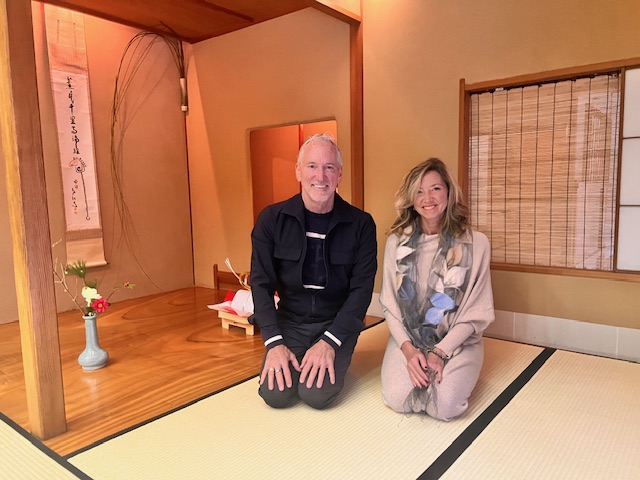
We were greeted with slippers at the door, shelves neatly stacked with matching pants, jackets, robes, and sashes to wear around the grounds and into town. A small basket held a towel and washcloth for walking from hot spring to hot spring. Everything had its place.
The food, like everything in Japan, was compact and intentional. Cars resembled metallic ice cubes—efficient and contained. A traditional Japanese breakfast arrived with sixteen small dishes, each offering a few bites of simple, clean, fresh food—quietly bursting with flavor and nourishment.
All of this brings me to the deeper question: What is the Ryokan Rx?
If you—your physical, emotional, mental, and spiritual self—were viewed as a house, how might you unclutter it? Where could you make space? What might that space invite in?
On this trip, I became aware of a new entity I have a relationship with. It’s called Information. And coming home completely refreshed, I realized that stepping away from Information was one of the most nourishing experiences I’ve had in a long time.
This was not a silent Vipassana retreat. But it was a retreat empty of texting, webinars, podcasts, audiobooks, and constant input. In that emptiness, something else moved in—the taste of unfamiliar foods, the sound of a foreign language, the rhythm of walking streets I had never walked before. Presence replaced consumption.
The value of space is the gift of the moment.
As we move into 2026, I’m naming this as medicine—and adding it to my favorite health practices.
My Favorite Health Hacks Right Now
- A 10-Minute Prayer Practice
Currently The Holy Incantation of Solace by Richard Rudd—an anchoring daily ritual that softens the nervous system and restores inner coherence. - The First 15 Minutes of Michael Chang’s Daily Workout
Gentle, rhythmic movement to wake the body, lubricate joints, support lymphatic flow, and create momentum without depletion. - Luscious Sauna Therapy
Two to four times per week for 20–40 minutes to support detoxification, release microplastics and heavy metals, loosen fascia, and induce deep parasympathetic rest. - SPACE — The Ryokan Rx
Intentional space-making as medicine. Clearing clutter, easing mental load, fasting from information, and allowing the system to breathe. SPACE is not emptiness—it is capacity.
What’s New for 2026
- The lab I'm most excited about: Intellexx DNA
The lab I’m most excited about for 2026. A next-generation genomic and epigenetic assessment that helps us work with your unique blueprint for prevention, resilience, and longevity. - The new therapy I'm most excited about: Peptides
- Practice Transition
I’m changing both my practice location and the structure of my clinical work to create a more spacious, sustainable, and deeply personalized model of care. More details to come soon. - Expanded Energy Medicine Hours
I’m opening more availability for energy medicine sessions, allowing deeper work at the level beneath symptoms—supporting coherence, regulation, and healing.
2026 is about clarity, precision, and making room for what matters most.
Sometimes healing is not about adding more.
Sometimes it is about clearing the room.

