
The Three Marriages & a Return to the Landscape
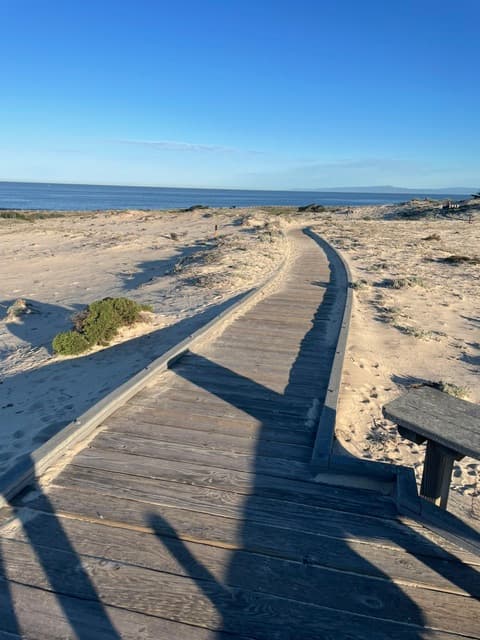
This Spring, my partner and I attended a weekend immersion with the poet David Whyte at Asilomar, titled The Three Marriages. Set along the wild coastline just north of Carmel, it felt less like a workshop and more like a remembering—a kind of medicine for the soul.
Whyte speaks of three essential marriages: our relationship to our work, to ourselves, and to those we love. These are not separate domains, but living conversations—constantly shaping and reshaping one another.
As I listened, I realized this inquiry has been quietly living in me since childhood. A lifelong weaving—through fascia and feeling, through thought and instinct—asking: How do we belong fully to our lives?
What stayed with me most was not just the ideas, but the invitation:
To live in deeper connection, context, curiosity, and collaboration—the true currency of a meaningful life.
And from that place, something softer emerged:
A love not driven by performance or achievement, but one that is unnamable, unencumbered, and quietly radiant.
A Journey Back
Shortly after, I traveled to Spain—back to my father’s hometown, where he spent the last 30 years of his life.
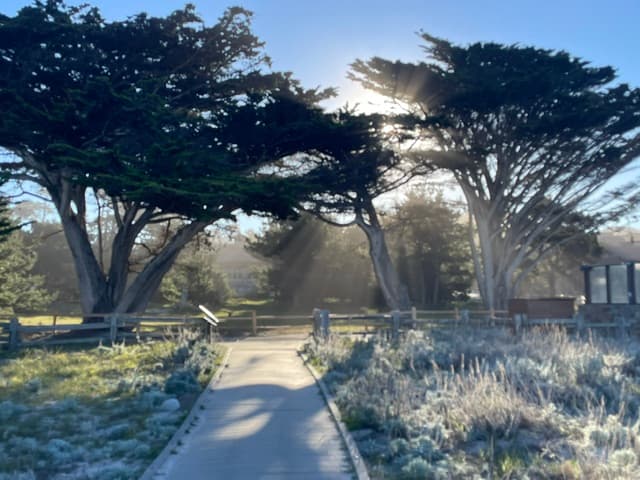
It felt less like a trip, and more like a sojourn—a pilgrimage into memory, landscape, and something older than both.
There, the land itself became the teacher.
Cycling along quiet, winding roads, I found myself immersed in a rhythm that required nothing of me. Red poppies flickered along the edges of the path. Yellow fennel and wild white blooms swayed in the breeze. A herd of sheep rushed down a hillside, their bells echoing through the valley. Birds moved in small, animated gatherings. A grasshopper leapt across the road as if part of the choreography.
The mountains curved and folded like an ancient dragon—alive with stories, patient and enduring.
There were no factories. No urgency. No sense of striving.
And something in me softened.
The Medicine of the Landscape
In that place, I realized:
The world does not need to be made beautiful—it already is.
We simply need to slow down enough to perceive it.
As Whyte writes, we are invited to take “a half step into self-forgetting”—and in that step, something essential is restored.
Without effort, without technique, without trying to “get somewhere,” I found myself simply being with what is.
And it was enough.
More than enough.
There was a quiet revelation there:
That the constant drive to improve, optimize, and perform—so deeply embedded in modern life—can obscure a more fundamental truth:
We are already held within something whole.
Returning to the Body
What became clear to me, both in the teachings and in the landscape, is this:
If we are to truly live these three marriages—
we must include the body.
The body is not an afterthought.
It is the vessel through which we experience beauty, connection, and meaning.
To neglect it is to slowly lose access to the very life we are trying to create.
And alongside this came a deep remembering of what I would call the divine feminine intelligence within us:
A way of being that is receptive, curious, open-hearted.
A way that does not force—but allows.
Does not strive—but listens.
It is here, in this space, that we rediscover the quiet enchantment of being alive.
How This Shapes My Work
When I returned to my clinical practice, I began to see more clearly what I am actually listening for when a patient lies on the table.
Not just symptoms.
Not just lab values.
But the place where something in the system has lost its rhythm.
In osteopathic medicine, we are trained to feel for motion—subtle expressions of life within the body: the movement of cranial bones, the flow of cerebrospinal fluid, the tone of the nervous system.
But what this journey clarified for me is that these are not just mechanical phenomena.
They are expressions of relationship.
Relationship between structure and function.
Between nervous system and environment.
Between the physical body and the more subtle fields that inform it.
Often, there is a single point—a place of convergence—where physical tension, emotional experience, and lived history are held together.
When that point is gently engaged, the system begins to reorganize.
Not through force.
But through listening.
This is the essence of the work I now feel even more deeply committed to:
Creating the conditions in which the body can remember its own coherence.
A Gentle Invitation
We are living in a time of great complexity and acceleration. It is easy to feel pulled outward—into urgency, into noise, into fragmentation.
But there is another way.
A way of returning:
To the body
To the breath
To the landscape—both within and around us
A way of remembering that healing does not always come from doing more.
Sometimes, it comes from stepping just beyond ourselves…
and allowing what we encounter there to restore us.
For those who feel called to explore this work more directly, I’ve begun offering a new 45-min session called NeuroEnergetic Alignment—a synthesis of osteopathic care, targeted peptide therapy, and energy medicine, designed to restore coherence across the body, mind, and subtle field.
You can learn more or schedule a session here:
https://www.drjacqueline.com/neuroenergeticalignment

